- SAA wins top African airline award at travel market
- Airlines debt crisis triggers safety concerns, Bernard urges NCAA financial audit
- Insurance protection gap threatens Nigeria’s economic resilience
- Air Peace, NCAA lock horns over performance metrics
- Berthe: African Airlines struggle with minimal profit margins amid rapid passenger growth



The deepening dilemma of Nigeria’s aviation funding

In the high-stakes world of aviation, safety margins are rarely compromised by a single failure; they erode slowly under the weight of systemic neglect. Right now, the financial crisis rocking the Nigerian Airspace Management Agency (NAMA) exposes a complex industry dilemma, writes WOLE SHADARE
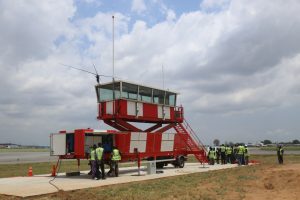
The financial crisis rocking the Nigerian Airspace Management Agency (NAMA) has taken a dramatic turn, with the agency’s unions warning of total operational insolvency as domestic debt hits ₦34.69 billion and foreign receivables climb past $49 million.

Faced with an obsolete domestic tariff structure and severe delays in statutory allocations, NAMA is urgently pushing for a comprehensive review of its share of the 5% Ticket Sales Charge (TSC).
The operational burden on NAMA is unique, heavily capital-intensive, and highly sensitive to macroeconomic shocks. While commercial airlines regularly adjust their ticket pricing to keep pace with rampant inflation and foreign-exchange volatility, NAMA has historically struggled with stagnant revenue models.
To put it in proper perspective, the silent architecture of Nigeria’s airspace is fracturing under severe financial strain. The invisible network that keeps their aircraft safely separated, the communications, navigation, and surveillance systems managed by NAMA, is fighting a quiet war against obsolescence.
The agency’s core domestic funding stream remains heavily dependent on the 5% TSC, which is collected from passengers and pooled by the Nigeria Civil Aviation Authority (NCAA) to support key industry organs.
However, aviation unions recently raised the alarm, alleging that the NCAA has failed to remit NAMA’s statutory 23% share of the TSC for four consecutive months.
Compounding the crisis is a mountain of uncollected debt. The Federal Airports Authority of Nigeria (FAAN) leads the domestic debt profile, owing NAMA ₦23.94 billion, alongside billions more tied up with legacy and struggling domestic carriers.
This delay has choked the agency’s immediate liquidity, forcing it to manage critical communications, navigation, and surveillance systems on a near-empty purse.
At the centre of this looming crisis is a fierce debate over revenue sharing. With operational costs skyrocketing and foreign exchange shortages compounding equipment maintenance, a critical push is underway to increase NAMA’s share of the 5% Ticket Sales Charge (TSC) from 23% to 40% (and up to 60% by some estimates).
Yet, in an industry where every agency is starving for resources, robbing Peter to pay Paul presents a deeply complex dilemma.
Invisible Operational Burden
Unlike administrative organs of government, NAMA operates in a technology-intensive, capital-heavy environment. It is the Air Navigation Service Provider (ANSP) for a country with vast, rapidly growing airspace. Every advancement in commercial aircraft technology requires a corresponding, highly expensive upgrade on the ground.
Currently, the agency is facing a balance sheet of despair. The critical infrastructure that keeps Nigerian skies safe requires constant calibration, round-the-clock power resilience, and regular component replacement.
Because air navigation hardware is imported, NAMA is uniquely vulnerable to foreign exchange fluctuations.
Compounding this, local cash-starved airlines routinely fall into multi-billion-naira debt traps, using passenger-funded levies as informal working capital rather than passing them seamlessly to the regulatory and management agencies.
The cost of neglect in this sector is not measured in delayed paperwork; it is measured in safety margins. Without accelerated replacement of ageing navigation facilities, expanded surveillance coverage, and proper technical training for air traffic controllers, the system faces structural vulnerabilities.
The TSC tug-of-war
The proposal to adjust the TSC formula to heavily favour NAMA is structurally sound on paper. An influx of funds would immediately translate into preventing total system blackouts through better backup power and satellite communication networks, ensuring absolute visibility over high-altitude oceanic and domestic routes, and keeping technical personnel certified to international benchmarks.
Stakeholders, however, said a balanced view of the aviation ecosystem reveals why this adjustment is facing institutional resistance. The 5% TSC is a shared lifeblood. The NCAA relies on it for stringent safety oversight and economic regulation.
FAAN faces its own mountain of infrastructure deficits across terminal buildings and runways.
The NCAA, which oversees safety compliance and economic regulation across the industry, faces mounting enforcement costs.
Simultaneously, groups like the Airline Operators of Nigeria (AON) have expressed frustration with the current tax architecture, arguing that the TSC functions as an ad valorem tax on gross earnings, which severely devalues airline capacity.
Experts said, “Aviation safety is not a single pillar; it is a collaborative matrix. Effective regulation, precise meteorological data, modern airport management, and robust air navigation must complement each other. Starving one statutory agency to heal NAMA’s bleeding books could simply shift the safety vulnerability from the airspace to the tarmac or the regulatory desk.”
“Aviation safety is strongest when every agency is adequately resourced. However, equitable funding must reflect the actual capital intensity and operational demands of the institution managing the entire sky.”
They argued that if the government simply strips funding from the regulator or the meteorological services to shore up NAMA, it risks fixing the airspace while weakening safety oversight on the tarmac.
“Air navigation cannot happen in a silo. If we starve the regulatory framework to feed the equipment on the ground, we are simply shifting the safety vulnerability from the sky to the baseline structure of the industry.”
Way forward
The solution cannot simply be reduced to squabbling over percentages of a single revenue pool. If Nigeria genuinely intends to secure its position as Africa’s leading aviation hub, structural changes must go deeper by enforcing tighter financial discipline on domestic carriers to ensure that collected passenger fees are immediately remitted to service providers like NAMA, moving away from institutional competition toward shared infrastructure goals, treating airspace management not as an administrative cost center, but as a critical arm of national security and economic infrastructure requiring direct federal intervention.
Also, fixing NAMA’s structural deficit requires moving beyond endless turf wars over the TSC pool. A balanced resolution relies on three clear policy shifts, such as establishing an independent, automated collection framework that strips airlines and the NCAA of direct handling of NAMA’s portion of passenger fees, ensuring real-time liquidity.
It equally involves the Ministry of Aviation intervening directly to enforce debt settlement plans on FAAN, debtor state governments, and commercial carriers currently using NAMA’s capital to balance their own books and treating the national airspace as critical security infrastructure rather than a self-sustaining commercial entity, allocating direct federal capital grants for major radar and communication overhauls.

Last line
Ultimately, the cost of safe skies has fundamentally changed. If the funding mechanism does not evolve alongside the tech, Nigeria’s aviation industry risks flying blind into its next decade.
Google+